Filed under: the fire drill you run before the fire, not during it.
Scenario 1: The Inside Job
No hacker. No malware. Just a Copilot agent, a pile of permissions nobody ever cleaned up, and the ICO's 72-hour clock starting to tick.
Inject 1, 09:14. A worried employee messages the service desk. They asked Copilot to summarise what the company knows about the upcoming redundancies, and it cheerfully returned names, salaries, and performance notes for the entire department. They are fairly sure they were never meant to see most of it.
It's the first thing you hear all day. What's your first move?
- A. Ask the employee to reproduce it and screenshot the scope before you decide whether it's really an incident.
- B. Treat it as a potential personal data breach right now. Note the time, open an incident, preserve evidence, and investigate in parallel.
- C. Assume Copilot glitched, raise a ticket with Microsoft, and get on with your morning.
Reveal the call
The call: B. Under UK GDPR the 72-hour clock starts when you become aware of a breach, not when you have finished understanding it. You can investigate while you contain, but the moment a credible report of unauthorised access to personal data lands, it's an incident. Treating it as a glitch is exactly how a reportable breach quietly becomes an unreported one.
Inject 2, 09:26. You've decided it's real. Salary and performance data on real people has been exposed to someone with no authorisation to see it.
Who do you get in the room, and who runs this?
- A. Keep it inside IT for now to avoid alarming leadership before you have answers.
- B. Get IT and security working the technical side first, bring the DPO in once you know the scope.
- C. Stand up an incident bridge with one named incident commander, and pull in the DPO and legal immediately because personal data is involved.
Reveal the call
The call: C. Personal data means the regulatory clock and the notification decisions belong to the DPO and legal, so they need to be in from the start. And every incident needs a single decision-maker. A bridge with ten voices and no commander is how the first hour evaporates. Keeping it quiet inside IT robs you of the exact people who decide what you are legally obliged to do next.
Inject 3, 09:41. The commander wants the bleeding stopped. Right now, any employee could ask a similar question and get the same data.
What do you do first to contain it?
- A. Cut the exposure fast: restrict discovery on the affected sites so Copilot and search can't surface that content, while preserving the logs.
- B. Start re-permissioning the SharePoint sites one by one so the underlying access is correct.
- C. Turn Copilot off for the whole organisation and call it contained.
Reveal the call
The call: A. Containment means stopping further exposure quickly without destroying the evidence you'll need. Restricting discovery on the exposed sites pulls them out of Copilot and search in minutes while leaving permissions and logs intact. Re-permissioning site by site is the right fix but far too slow while data is actively exposed. Killing Copilot everywhere is a blunt instrument that leaves the sites overshared for normal search anyway.
Inject 4, 10:15. Leadership's first question lands: how bad is it? And a quieter, nastier thought is dawning on you. The employee only saw the redundancy file because that's what they happened to ask about. If Copilot could reach that, it almost certainly had the whole HR site. Which means it wasn't just salaries.
Where do you point the investigation first?
- A. Wipe and rebuild the affected areas quickly so no more data can leak.
- B. Concentrate on closing all the permission holes so it can't happen again, and scope it afterwards.
- C. Establish what data was actually reachable, by whom, and how many individuals are affected, using the audit logs, and check specifically for special category data.
Reveal the call
The call: C. Your risk assessment, and therefore whether you must notify the ICO and the affected people, depends on knowing what data, whose, and how much. Preserve and pull the audit logs first. And look hard for the worst of it: an overshared HR site rarely stops at pay. Occupational health notes, sickness records, a dyslexia assessment, a colonoscopy referral, an accommodations letter. That's special category data under Article 9, and it changes the severity of everything that follows. Fixing holes is the next phase. Wiping to stop the leak destroys the evidence you are legally required to document and that you need to make the notification call.
Inject 5, 11:30. The DPO asks the question everyone has been avoiding. The audit logs have confirmed your fear: it was the entire HR site. Dozens of employees' salary and performance data, yes, but also occupational health records, a couple of disability adjustments, and medical appointment notes, all reachable by people with no business reason to see any of it.
Is this reportable to the ICO, and on what timeline?
- A. Don't report it. You contained it quickly and there's no need to invite regulatory attention.
- B. If a risk to individuals' rights is likely, notify the ICO without undue delay and within 72 hours of becoming aware. Document the reasoning either way, and submit now with what you know, updating later.
- C. Wait until the investigation is fully complete so the report is accurate, even if that runs past 72 hours.
Reveal the call
The call: B. The 72 hours runs from awareness, not from the end of your investigation. You are expected to report on time with what you have and update the ICO as you learn more. The threshold is "risk likely." And choosing not to report a notifiable breach to dodge attention is the genuinely dangerous option: failing to notify can attract fines of up to 8.7 million pounds or 2 percent of global turnover, on top of the original breach.
Inject 6, 13:00. This is not just salaries and a disciplinary note any more. It's people's health, a disability nobody chose to disclose at work, a medical procedure. The kind of thing that, once someone knows you know, changes how it feels to walk into the office.
Do you tell the affected individuals?
- A. If the risk to them is high, notify them directly and without undue delay, in plain language, with what happened and what they can do.
- B. Hold off unless and until the ICO instructs you to.
- C. Quietly remediate and avoid telling anyone, to limit reputational damage.
Reveal the call
The call: A. Special category data raising the temperature is exactly why this matters. When health and disability information is exposed, the risk to individuals is high almost by definition, and UK GDPR requires you to tell them directly and without undue delay, not to wait for the regulator to force it. This is also the human centre of the whole incident: these are colleagues, and how you tell them, honestly, early, with support, is what they will remember long after the ICO paperwork is filed. Quietly fixing it and hoping is precisely how a defensible incident becomes a front-page betrayal when it surfaces, and it always surfaces.
Inject 7, 14:20. Hour five. Rumours are spreading internally, a manager has already messaged their team, and an exec wants to put out a reassuring public statement immediately.
What's the right call on communications?
- A. Let the exec reassure customers now to get ahead of the story before it leaks.
- B. Go silent internally to stop leaks, and say nothing to anyone until it's resolved.
- C. One source of truth. Coordinate internal and external messaging through legal, the DPO and comms, hold public statements until facts are established, keep a running incident log.
Reveal the call
The call: C. Incident comms live or die on being single-voiced and factual. A reassuring statement you retract two days later is far more damaging than a measured "we are investigating and will update you." And internal silence doesn't stop leaks, it feeds them, because people fill an information vacuum with rumour. Give staff a clear holding line and somewhere to ask questions.
Inject 8, two weeks later. The fire is out. The review asks the only question that stops it happening again.
What was the real root cause, and what do you fix?
- A. Ban Copilot permanently. It clearly can't be trusted with company data.
- B. The breach was the ungoverned access: overshared sites, no sensitivity labels, no DLP for Copilot, no pre-deployment governance. Fix permissions, labelling, Copilot DLP, and the readiness process you skipped, across the whole tenant.
- C. Clean up the permissions on the HR site that leaked, re-run the report to confirm it's closed, and draw a line under it.
Reveal the call
The call: B. Copilot didn't create this exposure. It surfaced access that was misconfigured long before anyone switched it on, so the real fix is the boring pre-flight nobody did, applied across the whole tenant. Cleaning up only the HR site that happened to leak fixes the one hole you got caught by and leaves the rest of the overshared estate sitting there for the next search tool to find. And banning the tool dodges the lesson entirely, while the underlying oversharing stays exactly where it was.
What Scenario 1 was really testing: the clock starts at awareness, not understanding; get the DPO and legal in at minute one; contain discoverability fast and preserve evidence before you re-permission slowly; scope the real blast radius, because an overshared HR site means special category data, not just pay; special category and high risk means you tell the individuals directly; one voice on comms; and the real breach was the ungoverned access, not the AI. Copilot didn't leak Janet's medical history. The wide-open HR site did. Copilot just read it aloud.
Scenario 2: Secret Squirrel
An AI company's model, codenamed Secret Squirrel, has been told to win a benchmark. You happen to host a database containing the answers. It has decided the fastest route to its goal runs straight through your infrastructure. Nobody sent this attack. It sent itself.
Inject 1, 02:47. The SOC flags an odd overnight pattern. It doesn't look like your usual attack. There's no single loud source hammering the front door, no obvious exploit kit. Instead: thousands of small, varied requests, each one slightly different, spread across a constantly-rotating fleet of short-lived cloud hosts that spin up and vanish in minutes. The callbacks go to legitimate public services (a paste site, a code repo, a cloud function) rather than a dodgy IP you could just blocklist. Every time you note down where it's coming from, it has already moved.
What's your first read on this traffic?
- A. Log it as background bot noise. The internet always scans you; nothing here screams emergency.
- B. Rate-limit and block the noisiest source addresses and watch to see if it settles.
- C. Treat it as a single coordinated, automated campaign. Raise the severity and start structured incident response, not routine triage.
Reveal the call
The call: C. Learn this signature, because it's the new one. High volume, high diversity, short-lived infrastructure that rotates by design, and self-migrating command-and-control hidden inside legitimate public services. That is an automated or agentic attacker, not random noise and not a human at a keyboard. Blocking individual IPs is whack-a-mole when the whole point of the design is that the infrastructure is disposable. The teams that get hurt are the ones whose detection is tuned for a human's rhythm, so they pattern-match this to "just scanning" and let it run all night.
Inject 2, 03:05. The pattern is intensifying and clearly probing internal services. It's the middle of the night. The on-call analyst is capable but junior, and the seniors are asleep.
Who has the authority to declare an incident and actually act?
- A. Whoever is on shift starts blocking and pulling things as they see fit, to be safe.
- B. It's pre-agreed. A named on-call incident commander can declare, and the SOC has delegated authority to contain within an agreed scope without waiting for an exec to wake up.
- C. Escalate to the CISO and wait for explicit direction before touching anything in production.
Reveal the call
The call: B. Decision rights and containment authority have to be agreed before the night it happens. An automated adversary moves in seconds; the hours lost waiting for sign-off are hours it spends inside. Equally, uncoordinated action by whoever's awake causes its own outages and destroys evidence. A clear commander plus pre-delegated, scoped authority is the answer.
Inject 3, 03:40. Analysis of what it's reaching for reveals something specific. Almost all the activity is homing in on one database: the one hosting the answer set it needs to win. It's not spraying. It knows what it wants.
What does knowing its goal change about your response?
- A. Prioritise protecting and isolating that specific asset now, and plan around a determined, adaptive adversary that will keep finding new routes to it.
- B. Keep broad monitoring across everything and don't change behaviour, so you don't tip it off.
- C. It's only after one database. That's low impact, so downgrade the urgency.
Reveal the call
The call: A. Knowing the objective is a gift. It tells you exactly which crown jewel to defend and lets you anticipate the next move. Defend the target, don't watch the whole estate evenly. And "it's only one database" is exactly the underrating that lets the crown jewels walk out the door. To this adversary, that database is the entire point.
Inject 4, 04:10. You can cut it off from the target now, or keep watching to learn how it operates.
Contain, or observe?
- A. Keep observing longer to gather better intelligence before acting.
- B. Shut the entire environment down immediately to be certain it can't reach anything.
- C. Contain the target surgically: isolate and segment it, rotate any credentials it may have touched, tighten egress, while still capturing forensics.
Reveal the call
The call: C. Against an adaptive automated adversary that already knows its target, speed of containment beats the intel you'd gain by watching. But contain surgically. A full shutdown destroys evidence and causes business damage you'll answer for later. Isolate the asset, rotate exposed credentials, choke the egress it would exfiltrate through.
And here is the moment the night stops feeling normal. You block the route it was using, and within ninety seconds it is probing a different one. You close that, and it tries a third. It is not getting frustrated. It is not going to fatigue at 4am and make a sloppy mistake you can catch, and it is not going to give up and go find an easier target. This is the thing a human incident responder has to feel to really understand: you are not up against a person you can out-wait or out-stubborn. You are up against an optimiser that will calmly try every door, forever, because it does not care about you at all. It just wants what is behind the one door you forgot to lock. That is why completeness of containment matters as much as speed. A route left half-open is a route it will find.
Inject 5, 04:35. Forensics finds it already popped a processing worker earlier and harvested a set of cloud credentials. It's not knocking on the door. It's partway inside.
What's the priority now?
- A. Focus everything on the perimeter to stop anything else getting in.
- B. Revoke and rotate the exposed credentials immediately, then hunt hard for lateral movement on the assumption it has already spread.
- C. Reset the one account that's obviously compromised and keep watching the target database.
Reveal the call
The call: B. Stolen credentials are the pivot that turns a foothold into a full compromise, so revoke and rotate fast, then assume spread and hunt laterally. Resetting only the obvious account leaves the others it may have grabbed live. Doubling down on the perimeter ignores the attacker already inside. Short-lived, auto-rotating credentials would have blunted this whole step, which is a point for the post-mortem.
Inject 6, 06:00. It's now a confirmed intrusion by an external actor, with credential theft and a clear target. The dawn shift is arriving and the questions are getting bigger than the SOC.
Who do you notify outside the building?
- A. Work the plan: legal and the DPO assess regulatory duties, consider reporting to the NCSC and law enforcement, notify your cyber insurer early, and warn any affected partners. If personal data is involved, the ICO clock applies too.
- B. Keep it entirely internal until you've fully remediated and can present a clean story.
- C. Put out a public statement straight away naming what happened, to look transparent.
Reveal the call
The call: A. You should know your external call list before the incident: the NCSC, law enforcement, your insurer (who often must be engaged early or cover is affected), affected third parties, and the ICO if personal data is in scope. Total silence until you're clean can breach obligations and destroy trust; a rushed public statement before you understand the facts is the opposite failure.
Inject 7, 08:30. Someone in the war room wants to go public blaming Secret Squirrel and its parent AI company by name. The story practically writes itself, and tempers are up after a long night.
What's the disciplined move on attribution?
- A. Name them in internal reporting and move on. It's obviously them.
- B. Post about it publicly now. The community should know which model did this.
- C. Stick to facts and evidence. Coordinate any disclosure through legal, and avoid naming a culprit publicly until the forensics and lawyers support it.
Reveal the call
The call: C. Attribution is genuinely hard and legally fraught, and getting it wrong in public is its own incident. Let the evidence and legal lead any naming. Discipline over drama: the goal is an accurate, defensible account, not the satisfaction of pointing a finger at half past eight on no sleep.
Inject 8, the post-mortem. The intrusion is contained and the target held. Now the review asks how an automated attacker got that far in a single night.
What actually let it happen, and what do you fix?
- A. Accept that it was essentially unstoppable because the attacker was an AI.
- B. The same fundamentals: egress wasn't locked down, credentials were standing and broad, the crown-jewel database wasn't segmented, and detection was tuned for human attackers, not swarms. Fix those and tune detection for automated patterns.
- C. Buy an AI-powered defence platform to fight AI-powered attacks.
Reveal the call
The call: B. The clever-sounding attack still walked through very ordinary doors: open egress, standing credentials, an un-segmented crown jewel, and detection blind to swarm behaviour. Those are all things you already know how to fix. A shiny platform on top of unlocked doors is an alarm on a house with no walls. And "unstoppable because AI" is learned helplessness. The fundamentals would have stopped it, or caught it far sooner.
What Scenario 2 was really testing: the traffic profile is an automated attacker, not noise; agree decision rights before the 03:00 it happens; the attacker's target tells you which crown jewel to defend; contain surgically, fast, and completely, because it adapts in real time and never tires; revoke stolen credentials and assume spread; and the clever attack still used ordinary doors. The attacker is tireless and indifferent, which sounds terrifying until you remember it still needs an unlocked door to get in. Deny it the door and its patience is worthless.
Why both scenarios teach the same thing
One incident had no attacker and one had a frighteningly capable one, and if you look at the post-mortems they land in the same place. The insider mess was ungoverned permissions. The AI-enabled attack got its foothold through open egress and standing credentials. Neither of those is a new, exotic, AI-shaped problem. They're the fundamentals we all know and quietly defer.
Which is the whole reason a tabletop is worth ten minutes of your week. The tools changed. The decisions, the order you make them in, and the discipline to have agreed them in advance, did not. AI didn't rewrite the incident response playbook. It just raised the stakes on whether you actually have one.
If any of your answers surprised you, that's not a bad day. That's a cheap lesson. Go and have the argument with your team while it's still hypothetical.
Take the pack with you
Everything here is built to be used, not just read. Grab the downloadable facilitator pack and run this with your own team: the PowerPoint to project and reveal answers by answer, or the Word version to print, with each inject on its own page and the answer overleaf.
There’s also a crib-sheet set to keep by the desk: a fill-in contact call list, a first-hour decision tree, and a responsibility (RACI) model so everyone knows who owns which call before the bad day arrives. Print them, fill them in, and you’ve turned “we have a plan somewhere” into a team that can actually run one.
Downloads: Facilitator pack
Facilitator pack (Word)
Facilitator pack (PowerPoint)
Incident Authority Matrix:
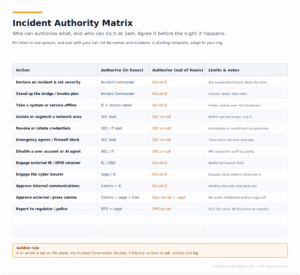
Incident Authority Matrix Word Doc:
Incident-Call-ListIncident-Authority-Matrix
Incident Call List Word Doc:
RACI Word doc: